.png)
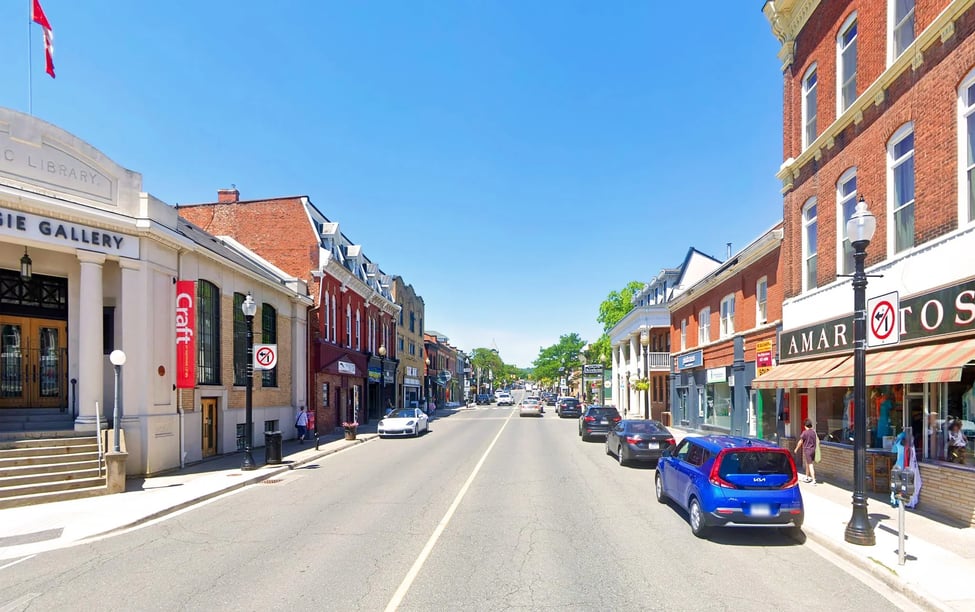
If you're looking at Hamilton and someone keeps steering you toward "the Valley Town," they're not wrong. Dundas is one of the most requested pockets in my business, and it's not hyped up for no reason. Here's the real breakdown — no fluff — on what it costs, what it feels like, and who it's actually right for.
The Vibe
Dundas doesn't feel like Hamilton, and that's the point. It's a village tucked at the base of the Niagara Escarpment, population holding steady around 20,000 for decades because it's boxed in by the protected Dundas Valley Conservation Area rather than sprawling outward. Main Street still looks like Main Street — independent shops, patios, a genuine downtown you can walk end to end. Buskerfest hits in June, the Cactus Festival takes over in August, and neither feels like a tourist trap. It's small-town texture with big-city access, which is exactly why it commands a premium.
Home Prices in 2026
Let's talk numbers, because this is where buyers get tripped up. Dundas benchmark pricing has been sitting in the $925K–$950K range, down roughly 8–11% year-over-year as the broader Hamilton-Burlington market corrects from pandemic-era highs. But here's the catch: Dundas trades in low volume. We're talking single-digit sales in some months, which means the "average" you see quoted can swing wildly — one month it's $928K, the next report shows $1.2M because two large detached homes closed and skewed the number. Don't trust a headline average without asking what actually sold.
What I can tell you with confidence: detached homes are the backbone of this market and they're holding value better than condos or townhomes citywide, which tracks — Dundas is overwhelmingly a detached, family-home market. If you're comparing it to Hamilton's citywide benchmark of roughly $744K, Dundas is running a meaningful premium, and that premium is the price of the walkability, the schools, and the escarpment backdrop.
The upside for buyers right now: this is a balanced-to-buyer's market. Days on market have stretched, inventory has grown, and you have room to negotiate that didn't exist three years ago. If Dundas has been on your list, 2026 is giving you leverage you haven't had in a long time.
Schools
This is a legitimate draw, not just a talking point. Dundas is served by the Hamilton-Wentworth District School Board, and its elementary zone is genuinely strong — all five Dundas elementary schools have landed in the region's Top 20 in recent rankings. Sir William Osler (JK–8, dual-track French Immersion from Grade 6) has posted a strong 8.0/10 on recent provincial rankings, and Yorkview feeds into Dundas Central for Grades 6–8. Everyone eventually lands at Dundas Valley Secondary School for high school. If you're house-hunting with kids, or planning to have them, the catchment matters — confirm the exact boundary for any address before you fall in love with it, because school zones can split a single street.
Parks and Outdoors
This is Dundas's real superpower. You're minutes from the Dundas Valley Conservation Area, one of the largest tracts of protected Carolinian forest in the region, with kilometres of hiking and biking trails right off the Bruce Trail. Websters Falls, Tew Falls, and Spencer Gorge are essentially in your backyard — some of the best waterfall access anywhere in the "Waterfall Capital of the World." If your buyers want green space without sacrificing walkability to a downtown core, there's nothing else in the Hamilton area that competes directly.
Transit and Commute
Be straight with your clients here: Dundas does not have its own GO station. Residents typically drive to Aldershot GO (Burlington) or West Harbour / Hamilton GO Centre, or connect via HSR bus routes into downtown Hamilton. Realistic door-to-door commute into Toronto runs 60–90+ minutes depending on route and traffic — plan around that honestly rather than underselling it. On the upside, Metrolinx has a Dundas Street bus rapid transit (BRT) proposal in the works, aimed at eventually improving the Hamilton-to-Toronto connection along that corridor. It's still in the planning stage, not built, but it's worth flagging for buyers thinking five-plus years out.
Who Dundas Is Actually For
Based on what I see close: young families prioritizing school catchments and trail access, move-up buyers leaving the GTA for more house and more nature without giving up a walkable core, and downsizers who want small-town charm without leaving the region. Proximity to McMaster also keeps a steady undercurrent of demand from faculty, grad students, and staff who want a short drive to campus without living in a student-heavy stretch — worth knowing if a rental component ever factors into your decision. It's a tougher sell for anyone needing a hard daily Toronto commute by transit — be upfront about that before they write an offer, since the drive-to-GO reality is the one trade-off that catches buyers off guard most often.
Ready to Talk Numbers?
Dundas moves fast when the right listing hits, and in a market this neighbourhood-specific, generic city-wide data won't cut it. If you're weighing Dundas against Ancaster, Waterdown, or the Mountain, let's get you real numbers for your exact situation.
Book a free consultation with me today, and I'll walk you through current inventory, realistic pricing, and whether Dundas is the right move for you.
— Chris Cipriani, RE/MAX Escarpment

